
Home / Pathways / Food Processing & Cold Chain
06 / HARVESTS + HEAT + COLD + DISTRIBUTION
Keep more of the harvest's value close to the farm.
A shared processing center receives harvests, stabilizes them by drying or freezing, then stores and distributes them. Power, heat and cold come from the same campus, so the center works as part of a wider system rather than a stand-alone building.
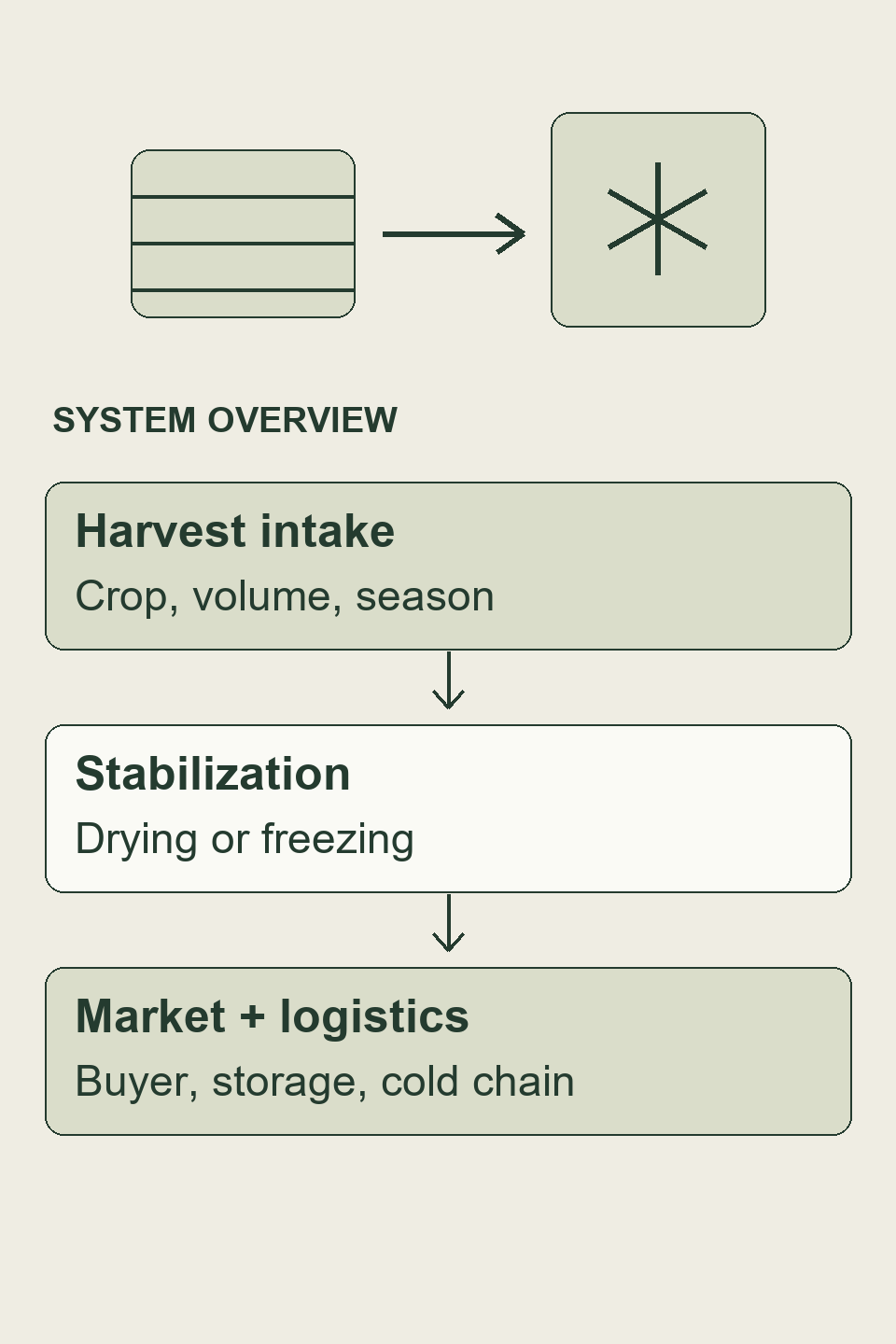
From harvest to buyer.
Stabilization and cold-chain capacity follow the crop, volume, season and buyer.
- Harvest intake → Crop, volume, season
- Stabilization → Drying or freezing
- Market + logistics → Buyer, storage, cold chain
The first decision is crop-to-market fit.
Name the crops, volumes and seasons you can supply, and the buyers who want stabilized product. The stabilization method and cold-chain capacity follow from those answers.
Two ways to stabilize a harvest
Thermal dehydration uses mesh-belt dryers heated by recovered computing heat through a heat exchanger and warm-water loop. Blast freezing moves product quickly into frozen or chilled storage. Many crops suit one method better than the other, and the mix can change with the season.
A shared facility for regional farms
The center can process crops from the campus and from surrounding small and mid-size farms on a toll basis. Clear terms, scheduling and quality grading decide whether shared capacity works for each farm.
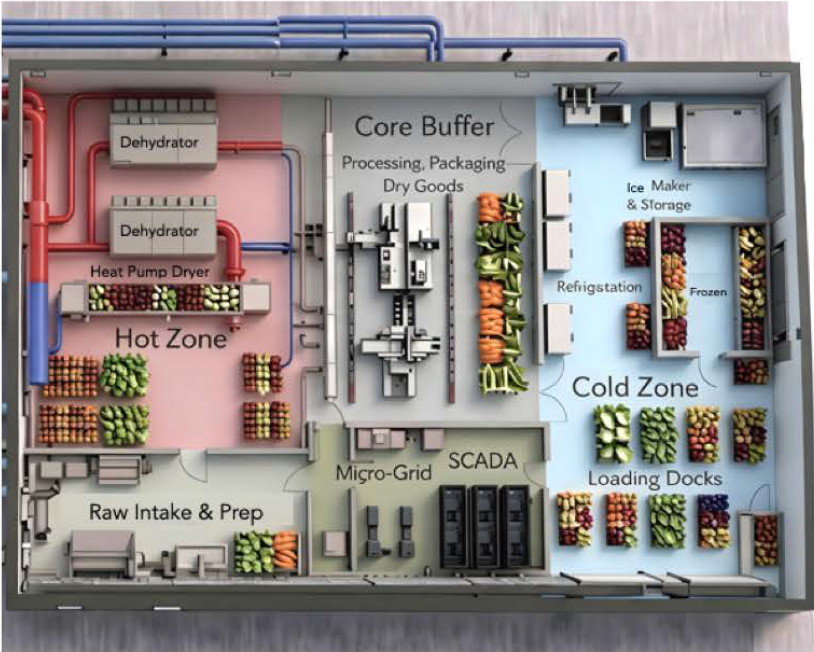
Processing-center floor plan. The layout requires site-specific design.
Power, heat and cold on one site
A shared DC microgrid runs refrigeration compressors and blast freezers. An electric refrigerated fleet distributes product and may serve as mobile battery reserve. Heat supply and drying demand both change with the season, so they are planned together.
Close the loop
Off-cuts and damaged produce can feed a black soldier fly system, and frass can return to crop fields. Waste intake and insect rearing stay physically separate from food-grade processing floors.
Food safety and permits
Plan for FSMA, USDA and FDA requirements as applicable, along with sanitation, wash water and traceability, before sizing equipment.
Build the economics
Model throughput by shift and season, utilization, toll fees, packaging, refrigeration energy, labor, compliance and transport. Keep design capacity separate from demonstrated throughput. Design basis: a building of about 100 × 60 ft (6,000 sq ft) handling about 1.75 t of wet biomass per 12-hour shift, or about 3.5 t a day on two shifts and about 1,200 t a year.
In the U.S., farms receive about 13 cents of each dollar spent on domestically produced food; the rest goes to processing, packaging, transport and retail (USDA ERS Food Dollar Series).
See it in an agri-hub
The integrated agri-hub shows how processing connects to solar, storage and the farm.
What to bring to an initial assessment
Crops and volumes by season; current storage and losses; buyers and distribution routes; available heat or power; interest in shared or toll processing.
Research and next steps
Connected Regeneration: a practical guide, a free 6-page PDF.