
Home / Agrivoltaics
LAND + AGRICULTURE + ENERGY
Keep agriculture at the center of solar design.
Agrivoltaics places solar electricity production alongside crops, livestock or other agricultural activity. The opportunity begins with the farm: its land, operations, water needs and plans for the next generation.

Design around the working farm.
Configuration follows crops, access, water and electricity demand. No yield or financial result is implied.
- Working farm → Crops, grazing and access
- Solar configuration → Height, spacing and storage
- Fit to verify → Farm income + energy costs
The first decision is agricultural fit.
Compare a concept layout with the working farm. What changes for machinery access, grazing or harvest? Which crop and shade assumptions need local evidence? Carry the farm-income comparison into the energy model.
Start with what the land needs.
Panel height, row spacing, orientation and access determine how a solar installation fits the work beneath and around it. Grazing, crop production and elevated arrays need different designs. Solar fencing offers another configuration to evaluate where field operations and boundaries make it appropriate.
The U.S. Department of Energy describes agrivoltaics as an active research area. A design that suits one crop and climate cannot simply be transferred to another.
Assess the food, energy, water and soil connections.
Map crop or livestock operations alongside electricity demand, irrigation, soil management and access. Evaluate storage against the actual load profile and grid connection. Decide which agricultural activities remain viable through construction, operation and eventual equipment replacement.
Our agrivoltaics approach connects solar and storage with the food-energy-water-soil system. That provides a useful design frame for investigating the fit at a particular farm or ranch.
Follow the harvest past the field gate as well. Nearby drying or cold storage can change which crops make sense and when they are harvested, and frass from insect processing can return to the fields.
Build the economics around the operating farm.
- Compare the installed cost of each configuration, including interconnection and agricultural adaptations.
- Separate self-consumed electricity, export revenue and lease arrangements.
- Include ongoing farm income, maintenance, insurance, access and replacement costs.
- Test shade, water and crop assumptions against local evidence.
What to bring to an initial assessment
A location and site plan, acreage, current crops or livestock, equipment clearances, electricity use, water arrangements and the project objective are a useful start. The next useful output is a concept layout and a list of technical and commercial questions for the appropriate specialists.
Compare the field and the equipment
Begin with crop requirements, machinery access and water delivery. Compare solar layouts with a suitable open-field control, recording field conditions, crop performance and generation. Storage and irrigation add questions about when power is available and when it is needed.
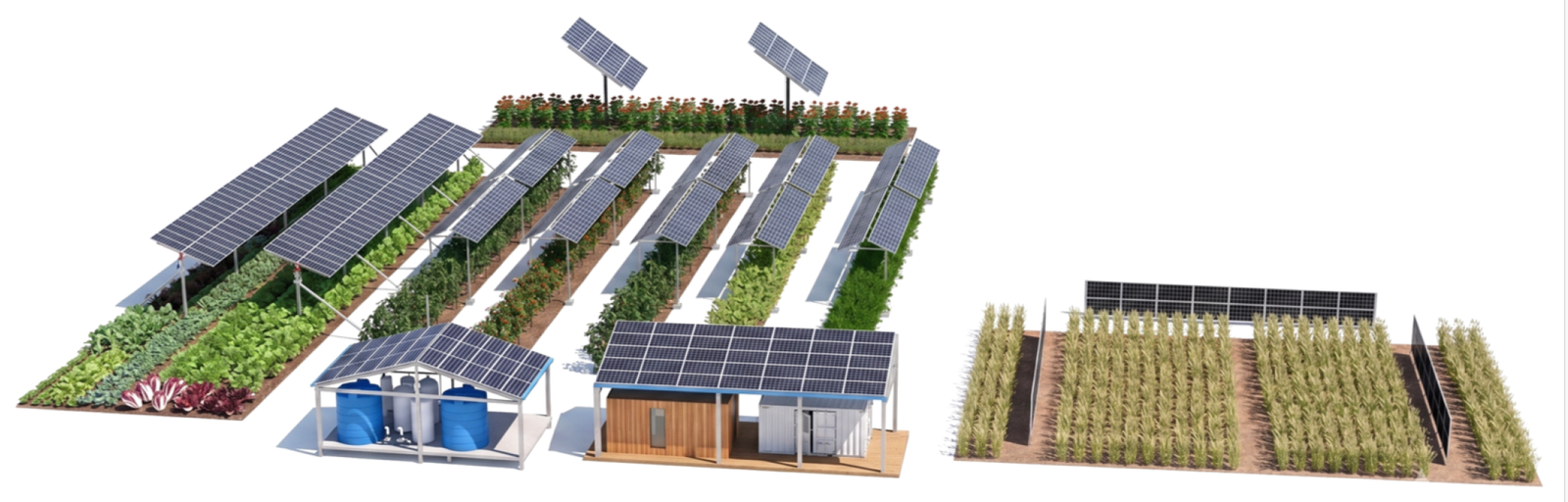
Agrivoltaic layouts for growing areas and solar equipment.
Research and next steps
Connected Regeneration: a practical guide, a free 6-page PDF.